Microcontroller firmware
Firmware on STM32 and ESP32: peripherals, real-time behaviour, power use, updates. Together with component selection, schematics and the printed circuit board.

Services / Embedded
Designing embedded systems, hardware and software together, is where we come from. Before writing our first line of web code we drew circuits, chose microcontrollers, designed FPGAs with soft-core processors and built dev kits that let other developers focus on their own work.
We design the electronics and software of devices that have to work in the field: control boards, sensors, connected machines. We work for companies that need to build a new product, update an existing one or connect their machines to networks, apps and the cloud, and don't have in-house people who can cover the whole path, from circuit to software.
Much of our embedded work is white-label: our clients put their name on it, so we don't mention them or the projects. That expertise, understanding the system from the silicon up, also changes how we approach purely software projects.
Services
Firmware on STM32 and ESP32: peripherals, real-time behaviour, power use, updates. Together with component selection, schematics and the printed circuit board.
Logic and soft-core processors synthesised inside an FPGA, when a microcontroller isn't fast or flexible enough. It is the technology behind the Merlino and Singularity boards.
CAN, Modbus and RS485 to get boards, sensors, PLCs and machines talking to each other, even when they come from different manufacturers.
We connect devices to web applications, apps and the cloud, and from there to AI services: data collected in the field becomes dashboards, alerts and analysis.
Industries
Industries where we have designed electronics and firmware. No names: much of the work is white-label.
What it can be
Examples of what can be designed with these skills. They are possibilities, not a list of projects we have built.
A custom board that drives a machine's motors, actuators and sensors, with its own interface.
Sensors read at regular intervals, data stored on the device and sent when a network is available.
A bridge that reads existing machines over CAN, Modbus or RS485 and brings the data into a web application.
Device status, alarms and new firmware without sending a technician on site.
Our history
It starts with a home-built computer: Salvo De Luca, founder of Dialogicom, designed his first computer around a Z80 processor and wrote on it, in assembly language, a management program used from three terminals. In 1991 came Dialogos, real-time chat for public venues, hardware and software, over an X.25 network. That was 35 years ago.
Then two boards born from his designs, with logic and soft-core processors synthesised inside an FPGA. Not textbook examples: the Merlino was shown at international trade fairs and featured by Altera, the chip maker. In 2008 we worked with CNR, Italy's National Research Council, on electronics for fuel cells.
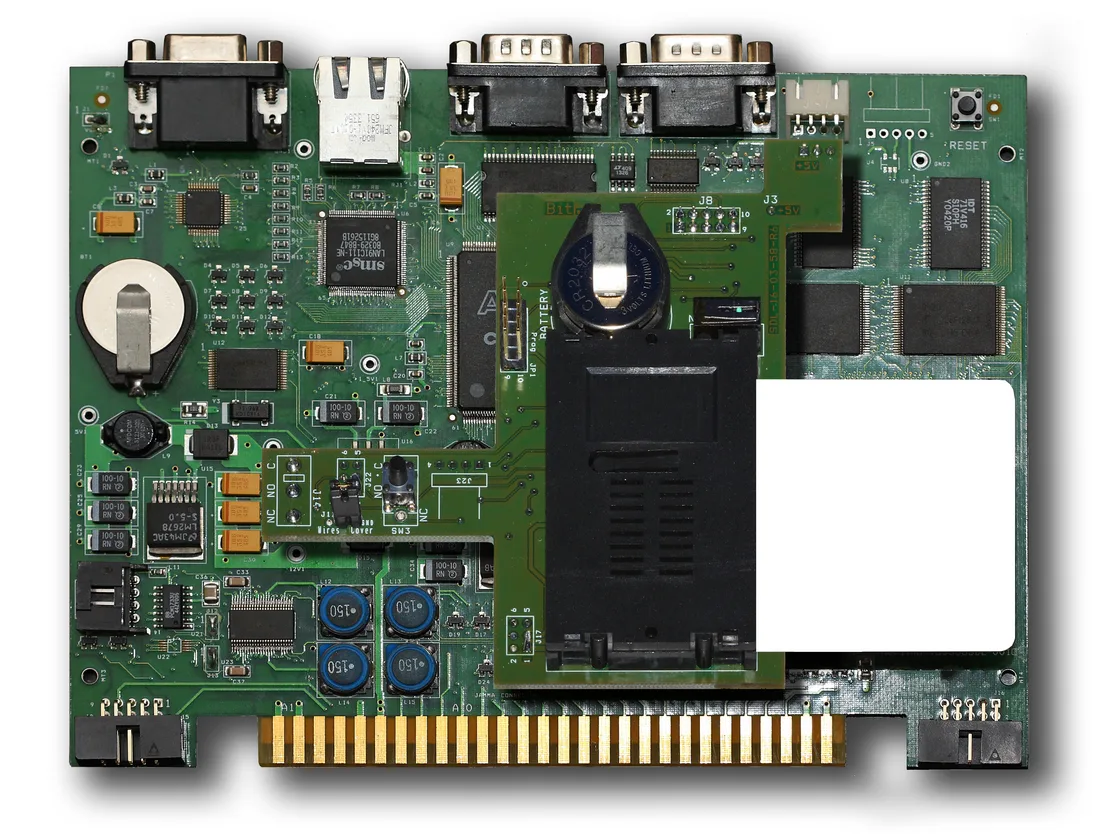 2005Merlino BoardAltera FPGA with a Nios II soft-core CPU, smart card, and gaming-authority compliance handled by the board.See the project →
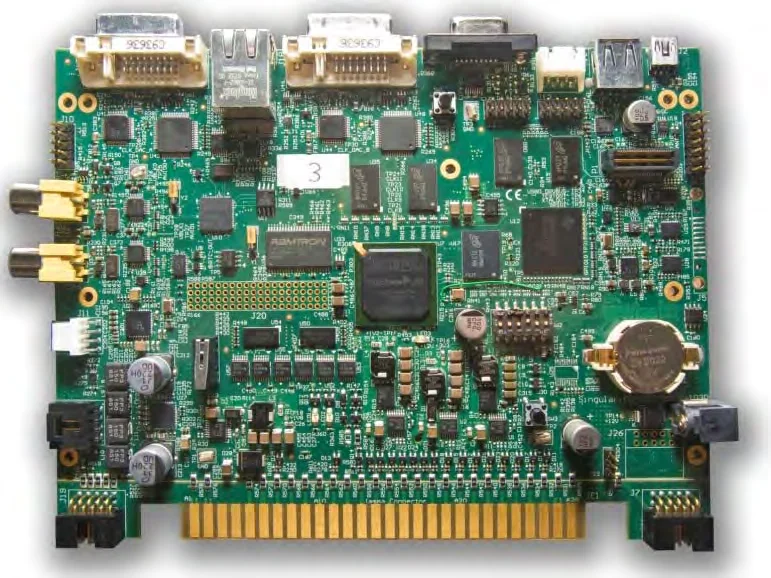 2009Singularity BoardThe evolution of the Merlino: FPGA SoPC architecture, 3D graphics processor and dual smart card.See the project →
Altera (now Intel), Customer Showcase: «The ability to develop custom instructions for the Nios II processor allowed us to transcend the limitations of traditional embedded architectures…» Salvo De Luca, Hardware and HDL Lead Designer.
How we work
What the device must do, in which environment, under which constraints of cost, power, certification and time.
Component selection, schematics, printed circuit board and firmware architecture.
Prototype, firmware and, where needed, the FPGA logic. Testing on the bench starts in the first days.
The device inside the machine and connected to the rest: field buses, apps, cloud.
Bench and field tests, then delivery with the documentation needed for production.
Firmware updates, fixes and new board revisions when components or requirements change.
FAQ
Mainly STM32 and ESP32. When we need speed or flexibility a microcontroller can't give, we move to an FPGA with soft-core processors.
Both: component selection, schematics, printed circuit board and firmware. We can also work only on the firmware of a board you already have.
Yes. We read the data from the buses the machines already use, such as CAN, Modbus or RS485, and bring it into a web application or an app, with dashboards and alerts.
Yes, often: we design it and the product ships under the client's brand. That is why our pages name neither clients nor embedded projects.
Automotive, agriculture, industry and automation, logistics and regulated gaming machines.
We can: firmware updates, fixes and new board revisions when a component goes out of production.
It's exactly the kind of problem we like to solve. We reply within 24 working hours.