Is it true?
Factual check with sources, confidence level and verdict.

Products · Communication
Real-time fact checking during interviews. TalkCheck listens to a conversation as it happens, picks out the verifiable claims, checks them against online sources and shows the results while the exchange is still going on.
Access by invitation, through a link sent to authorised email addresses.
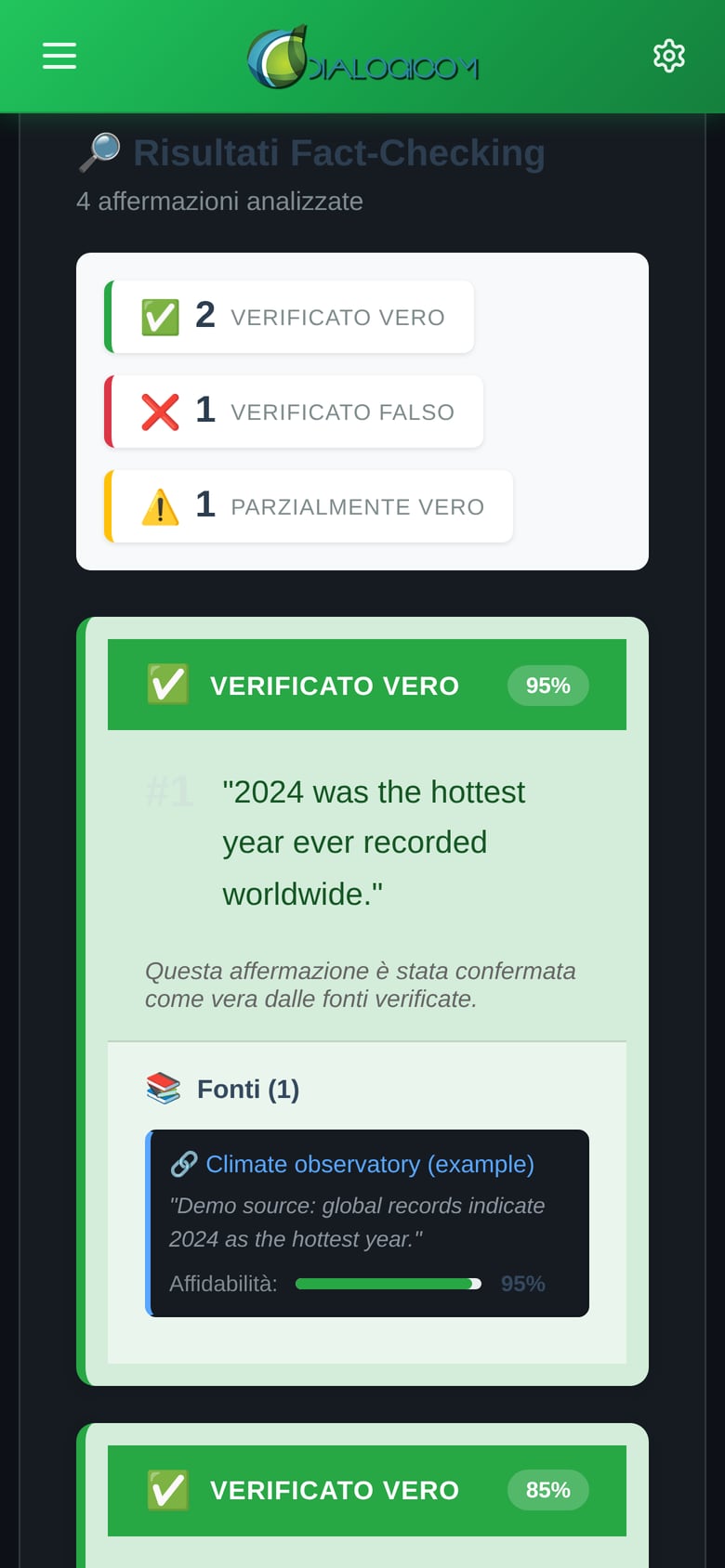
The decisive advantage. Shortening the time between a statement and the chance to check it, without breaking the flow of the conversation.
Function · Operational value
Factual check with sources, confidence level and verdict.
Detection of omissions, improper comparisons, data selection and other techniques that can make a formally correct figure misleading.
Check of the logical, temporal, quantitative and contextual consistency of the information given during the conversation.
Who it is for
Live checking, interview transcription, source research and follow-up analysis.
Comparing statements, checking the consistency of sequences, rebuilding the context and analysing contradictions.
Support during negotiations, interviews, meetings and complex discussions.
Transcription of lectures, interviews and audio material, which can be looked up again later.
Why TalkCheck is different from an ordinary fact checker
A simple true or false answer is not enough when the problem is understanding whether a figure has been cherry-picked, taken out of context or combined with other information in an inconsistent way.
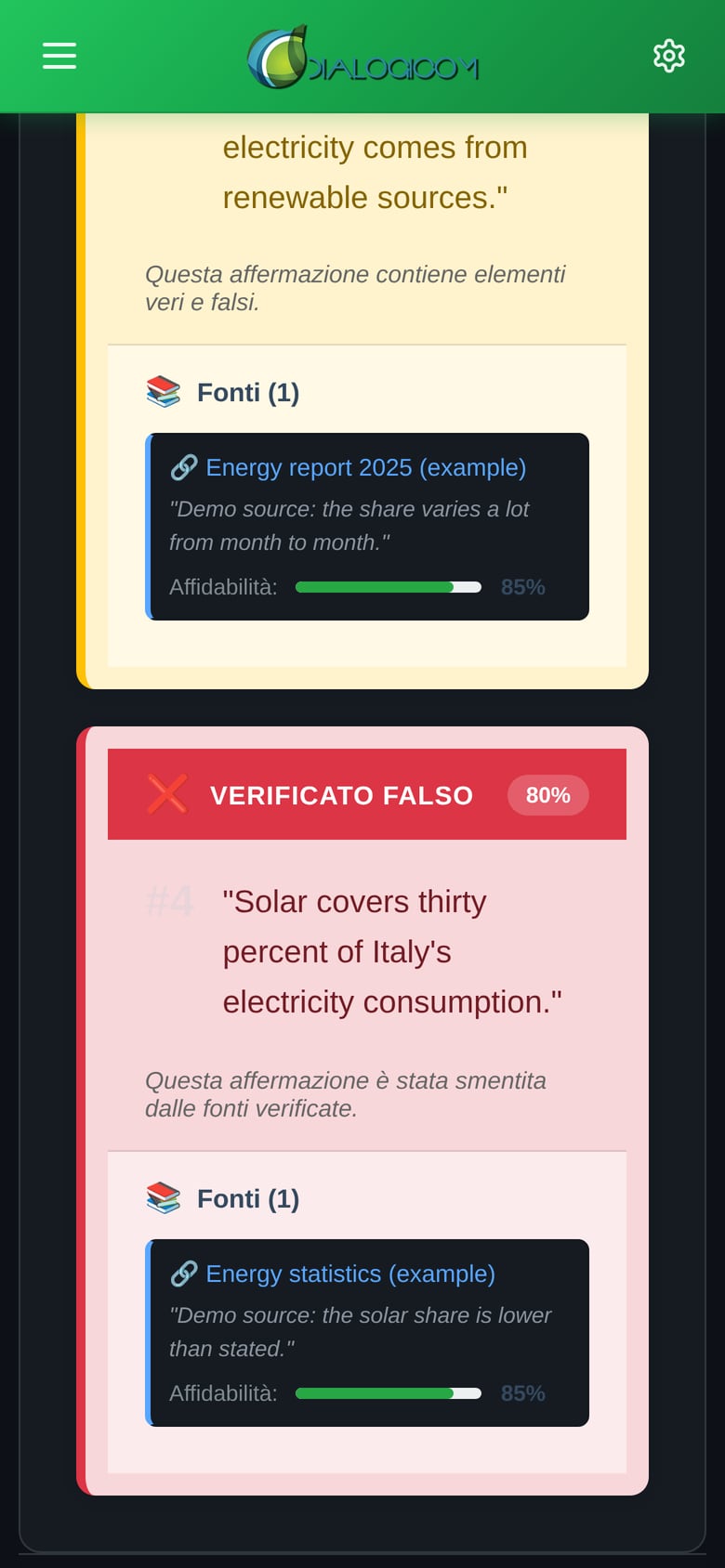
Checks start automatically while people speak, or the operator can request them when an immediate answer is needed.
A preliminary verdict lets you react quickly, followed by the full result with sources and confidence level.
TalkCheck does not look only at the single sentence: it relates what is said at different moments of the conversation.
1 · Live interview
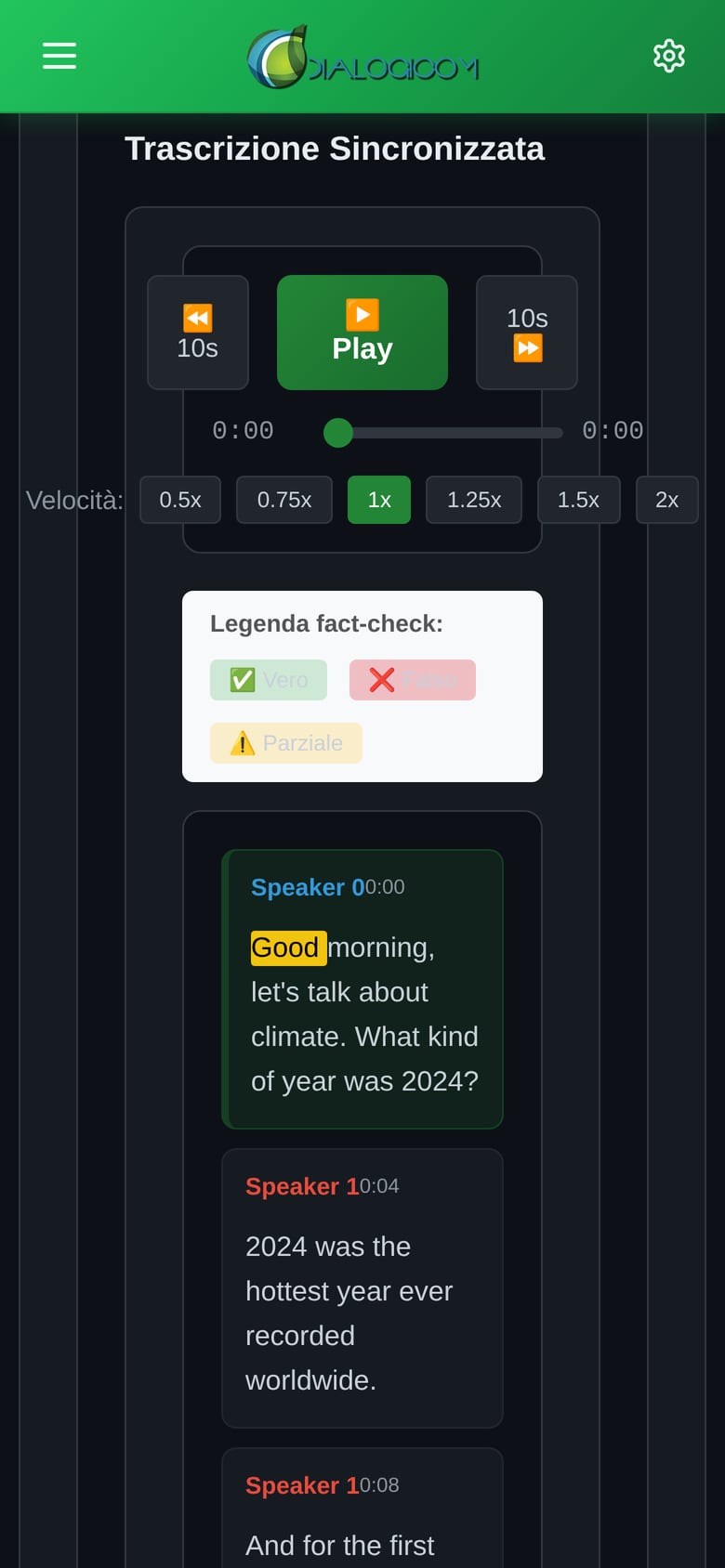
Verdict · Meaning
The claim turns out to be factually correct.
The claim turns out to be clearly wrong or seriously misleading.
It contains correct elements together with significant inaccuracies, omissions or distortions.
The available data do not allow a sufficiently reliable conclusion.
Opinions, forecasts or non-factual statements.
2 · Beyond true and false
TalkCheck can flag techniques that make a claim persuasive or misleading even when some of the figures quoted are real.
Picking only the favourable data and ignoring the data that change the overall picture.
Comparing cases that are not really comparable.
Giving authority to sources that are not qualified on the subject.
Percentages without absolute values, different comparison bases or time windows chosen to mislead.
Presenting extreme positions within a new frame of reference that changes how they are perceived.
Statements built to sound intuitive although the facts do not support them.
The key point. The question is not only whether the figure is correct, but whether it is presented correctly and with the context it needs.
3 · Consistency check and deductive analysis
TalkCheck can relate information given at different moments and detect logical, temporal, quantitative or contextual incompatibilities.
Example. “I left Catania by motorbike at 10:00 and arrived in Rome at 12:00 the same day.” Taken one by one, the times are plausible. It is their combination with the distance, the means of transport and the time available that makes the story inconsistent.
It does not only check the claims. It checks whether the story holds up.
4 · Prepare, dig deeper, question
Before a meeting you can research a topic or a person online, with sources cited, so you arrive at the conversation with a structured picture.
During the discussion TalkCheck can suggest questions built with the Socratic method, to test a premise without immediately turning the conversation into a head-on challenge.
After the analysis you can ask the system about the conversation, why a claim received a given verdict, recall the sources or find the points still open.
5 · Transcription, audio and translation
TalkCheck can also be used when real-time fact checking is not needed. An audio file already recorded can be transcribed with the speakers told apart and, when requested, put through the same checking chain as a live interview.
For · Operational value
Interview transcription, identification of the relevant claims, checking and sources.
Transcription of lectures and explanations to read and look up later.
Turning meetings, interviews and recorded conversations into searchable text.
Faster work on interviews and audio material collected in the field.
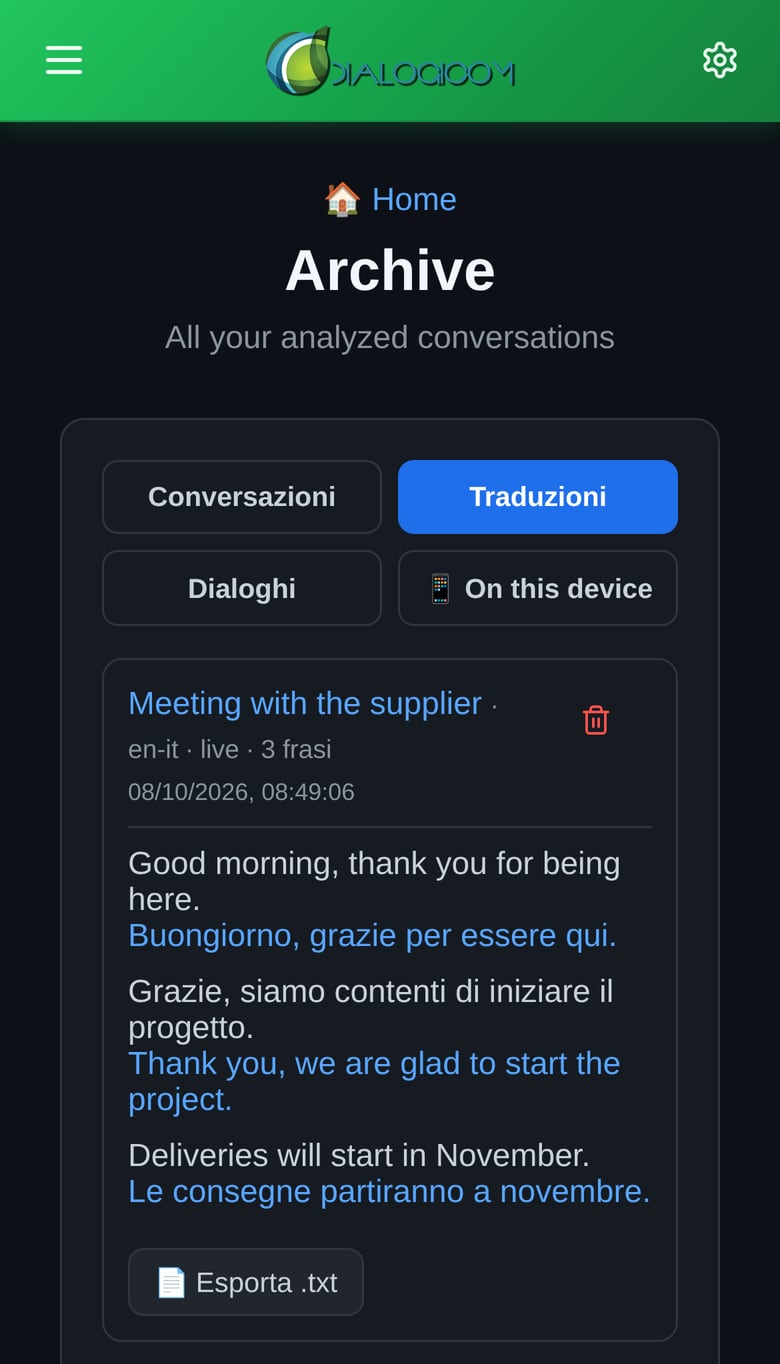
In the interpreter you choose the pair among six languages: Italian, English, Spanish, French, German and Japanese, the same as live transcription. Text and audio file translation adds Chinese and Korean, for eight languages in all.
6 · Archive, access and control
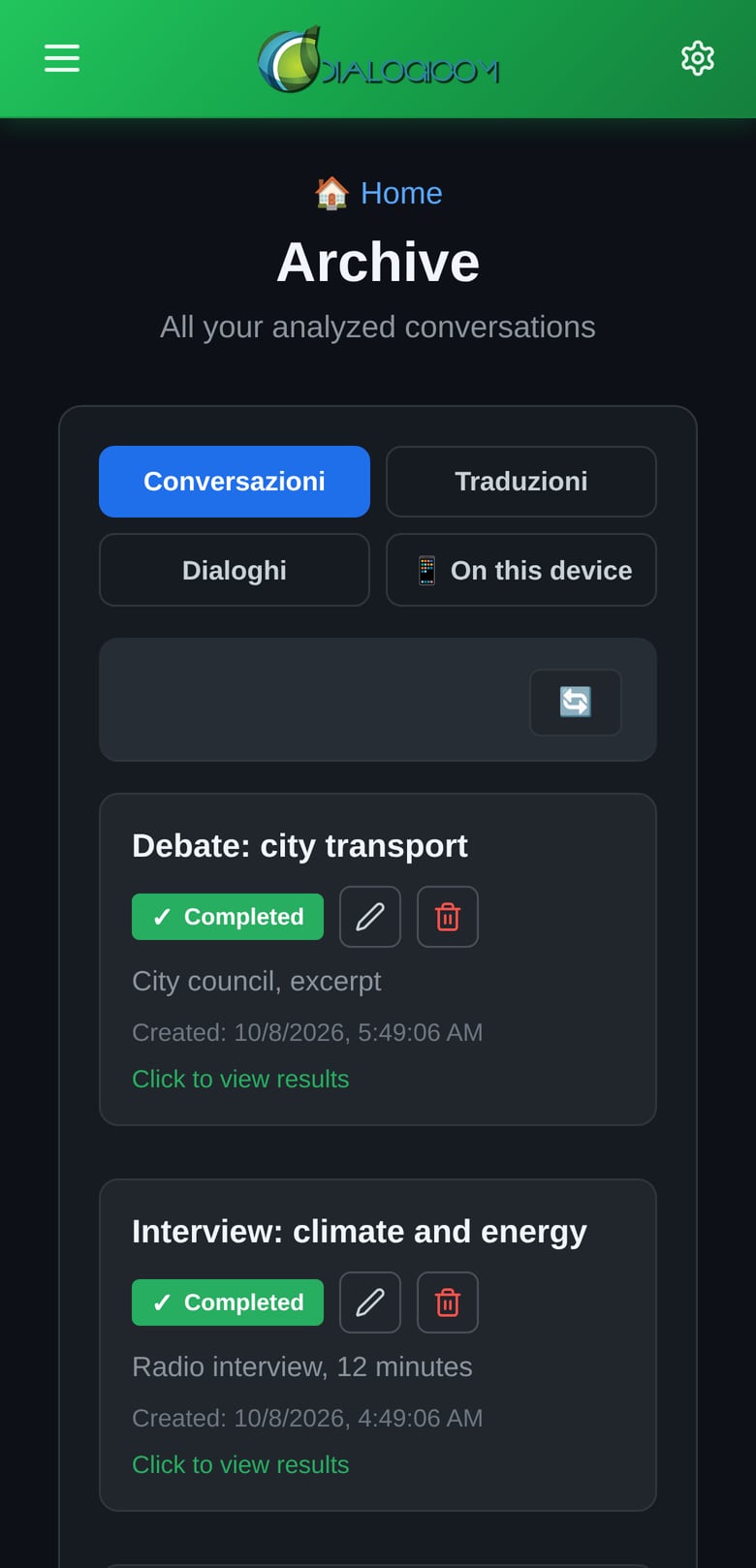
Full transcript with the speakers told apart, checked claims with verdicts and sources, audio playback synchronised with the text, later access to conversations and translation sessions.
It works in the browser on smartphones, tablets and computers, with no mandatory installation. It can be added to the home screen and used like a normal app. Access is through a link sent to authorised email addresses, with no password to remember.
Claim extraction, checking, deductive analysis, investigative analysis and chat can use different engines, to favour speed, depth or operating cost function by function, without tying the whole system to a single technology.
Checks can run a real search online. Sources are cited with a reliability indication, together with the confidence level of the verdict.
7 · What TalkCheck does not claim to be
TalkCheck is a tool that supports checking and decision making. The results show sources and confidence level because the operator must be able to check them.
Transcribes the conversation and tells the speakers apart.
Extracts the claims that can be checked.
Compares the facts with online sources and shows the confidence level.
Recognises manipulation and flags information presented in a misleading way.
Checks consistency between statements, times, quantities and context.
Suggests questions, analyses contradictions and allows follow-up questions.
TalkCheck brings fact checking into the conversation, while there is still time to ask the next question.